A Guide to Extra Time in Exams for Students with ADHD
Unlock support you deserve. Our guide covers extra time in exams, JCQ rules, and DSA for ADHD students in the UK. Learn to navigate the process.
Written and maintained by the ADHD Private editorial team, drawing on NHS, NICE and ADHD UK guidance. This is general information, not medical advice.
When people hear "extra time in exams," they often picture a student getting an unfair boost. The reality is quite different. For students with conditions like ADHD, it's about levelling the playing field, with the standard adjustment being a 25% time extension for exams like GCSEs and A-Levels. This isn't about getting an advantage; it's about getting a fair shot to show what you know.
What Extra Time in Exams Actually Means

Let's clear up a common misconception. Extra time isn't a "golden ticket" to better grades. It’s what the Joint Council for Qualifications (JCQ) officially calls a ‘reasonable adjustment’. The entire point is to remove or at least reduce the disadvantages that students with disabilities or learning differences face in a standardised test environment.
It’s not just given out lightly. This support is for students who have a diagnosed condition that genuinely puts them at a disadvantage under strict time pressure. For a student with ADHD, for instance, a standard exam can feel like a battle against the clock and their own brain. They might struggle with focus, organising their thoughts, or simply processing the questions as quickly as their peers.
Extra time gives them the breathing room to properly read a question, process it, structure a coherent answer, and write it down without their processing speed being the main thing that's tested.
"Extra time isn't about making the exam easier; it's about making it accessible. The adjustment allows students the mental space to decode questions and articulate their answers without their processing speed becoming the main obstacle to success."
Who Is Eligible for This Support?
Eligibility isn't tied to a single diagnosis. Instead, it’s all about demonstrating a clear, substantial need that puts a student at a disadvantage in timed exams. The JCQ sets out very specific guidelines for schools to make sure the system is fair and consistent for everyone.
A whole range of challenges can make a student eligible. These often include:
- Specific Learning Difficulties (SpLDs), such as dyslexia, dyspraxia, and dyscalculia.
- Neurodevelopmental conditions, most commonly Attention Deficit Hyperactivity Disorder (ADHD) and Autism Spectrum Condition (ASC).
- Physical disabilities that slow down writing or cause fatigue.
- Processing speed difficulties, where someone just takes longer to read and make sense of information.
- Mental health conditions like severe anxiety that can cripple concentration.
The most common arrangement by far is a 25% time extension. So, for a two-hour paper, that’s an extra 30 minutes. In some very specific and severe cases, a student might be granted 50% extra time, but this is much rarer and requires extensive evidence.
Common Exam Access Arrangements at a Glance
Extra time is just one type of support available. To give you a clearer picture, here’s a quick rundown of the most common access arrangements schools can put in place.
| Arrangement Type | What It Means | Commonly For |
|---|---|---|
| 25% Extra Time | The most common adjustment, providing a 25% extension on the standard exam time. | ADHD, dyslexia, slow processing speed, physical disabilities affecting writing speed. |
| Reader | A person reads the exam questions aloud to the student. | Students with severe reading difficulties (dyslexia) or a visual impairment. |
| Scribe (Amanuensis) | A person writes down the student's dictated answers. | Students with physical disabilities preventing writing, or severe dyspraxia/dysgraphia. |
| Word Processor | Using a computer to type answers instead of handwriting. | Illegible handwriting, severe dysgraphia, or a physical condition that makes writing painful or extremely slow. |
| Rest Breaks | Supervised breaks that do not count towards the exam time. | Conditions causing fatigue, anxiety, or attention difficulties (like ADHD), allowing for moments to refocus. |
| Separate Room | Taking the exam in a smaller, quieter room away from the main hall. | Students with high anxiety, ASC, or those who are easily distracted (ADHD) and need a low-stimulus setting. |
These arrangements are all designed with one goal in mind: to ensure the exam result reflects a student's academic ability, not their disability.
The Scale of Exam Adjustments
You might be surprised to learn how many students receive this kind of support. It's more common than you think, but it's not a free-for-all.
In the UK, 25% extra time is the most frequent adjustment, accounting for 67.2% of all 624,975 approved access arrangements in the 2023-2024 academic year.
While some initial reports suggested a huge jump to over 30% of candidates receiving support, Ofqual later clarified the figure is closer to 14%. This number actually aligns well with national data on pupils with Special Educational Needs (SEN). This context is crucial—it shows that extra time isn't a loophole, but a vital support system that reflects the real needs of the student population.
Building Your Case: Gathering the Right Evidence
Getting extra time in an exam isn't as simple as just having a diagnosis. What the exam boards are looking for is a clear, consistent story that proves this support is genuinely needed. Think of it as building a case, and your school’s Special Educational Needs Coordinator (SENCo) is the one who has to present it.
This case needs solid proof from two main sources: the school's own records and a formal diagnostic assessment. One without the other is often not enough. A diagnosis is a powerful piece of the puzzle, but it’s the evidence from day-to-day school life that really paints the full picture and gets an application over the line.
The Paper Trail: Establishing a History of Need at School
The absolute foundation of any request for extra time is the evidence gathered at school. The rules from the Joint Council for Qualifications (JCQ), which sets the standards for exams, are crystal clear on this. Any support given in a formal exam must reflect the student's 'normal way of working'.
This means you can't simply ask for 25% extra time in the final GCSEs if there’s no history of it being used and needed in class, for homework, or during mock exams. The SENCo needs to show a clear pattern.
This is the kind of proof they’ll be looking for:
- Teacher Observations: Notes and reports from teachers are gold dust. A history teacher might report that a student consistently fails to finish essays in timed conditions, despite clearly knowing the material. Or a science teacher might observe them struggling to complete all the questions in an end-of-topic test.
- Mock Exam Results: This is probably the single most compelling piece of evidence. Let's say a student gets a Grade 5 in a timed mock. But when they resit a similar paper with extra time, they achieve a Grade 7. That's a powerful, direct link showing the adjustment allows them to demonstrate their true ability.
- In-Class Work: Timed essays, practice questions, and mini-tests all contribute. If there's a consistent record of work being left unfinished due to time pressure, it all helps build that essential picture of need.
This internal evidence is what proves the need is real and present in the classroom, not just a theoretical problem described on a piece of paper.
The Expert Witness: The Role of a Formal Diagnostic Report
While the school's evidence shows what is happening, a formal diagnostic report explains why. For a condition like ADHD, this report is the cornerstone that holds the entire application together.
It shifts the narrative from "this student works slowly" to "this student has a neurodevelopmental condition that impacts their processing speed and executive function." A good diagnostic report, whether from the NHS or a private clinic, does more than just confirm a diagnosis.
A truly effective assessment provides the 'why' behind the struggle. It should contain standardised scores for cognitive functions like working memory and processing speed, giving the SENCo the concrete data they need to justify the request to the exam board.
For example, a report might show that while a student’s overall IQ is well above average, their processing speed score is in the 20th percentile. This kind of objective data is incredibly persuasive. It gives the SENCo exactly what they need to make a watertight case.
How a Private ADHD Assessment Can Help
We all know NHS waiting lists for ADHD assessments can be incredibly long, sometimes stretching into years. With exams on the horizon, that timeline just doesn't work. This is why many families decide to go to private clinics for a timely diagnosis.
A high-quality private assessment provides the robust, detailed evidence needed for an extra time application, but on a much faster timescale. This can be a lifesaver when you're up against JCQ deadlines for submitting access arrangements.
If you go down this route, it's crucial to choose a reputable clinic whose assessments are compliant with NICE guidelines. The final report will carry the same weight as an NHS diagnosis when applying for exam support.
It's also worth looking into the NHS Right to Choose pathway, which can sometimes allow you to access a private assessment with NHS funding, speeding things up considerably. You can learn more about how Right to Choose for ADHD assessments works to see if it’s an option for you.
Ultimately, the school records and the formal diagnosis are two sides of the same coin. The SENCo uses the diagnostic report to understand the root cause and the school's evidence to show its real-world impact. This two-pronged approach is, without a doubt, the strongest way to secure the support your child needs to have a fair chance at success.
Ready to compare clinics?
Answer a few questions and we’ll shortlist private ADHD clinics that fit — free to use, and independent.
How to Navigate the School Application Process
Once you’ve got your evidence lined up, it’s time to work directly with your school or college. This is the crucial stage where you formally request the extra time, and it all happens through the school itself. For things to go smoothly, building a strong, positive relationship with the right person on staff is everything.
That person is almost always the Special Educational Needs Coordinator (SENCo) or someone on the learning support team. They are the ones who pull together all the paperwork and submit the official application to the exam boards via the Joint Council for Qualifications (JCQ) portal. Think of them as your expert guide and partner in this.
Initiating the Conversation with the SENCo
If there’s one golden rule, it’s this: start early. The deadlines for these ‘access arrangements’ creep up much faster than most parents and students expect. If you wait until the mock exams are looming, you could easily be too late, which just adds a whole lot of unnecessary stress and could mean missing the window completely.
A good rule of thumb is to book a meeting with the SENCo right at the start of the academic year when the exams are scheduled (for instance, the beginning of Year 10 for GCSEs). This gives everyone plenty of breathing room to gather what’s needed, run any in-school assessments, and make sure the application is rock-solid.
To get the most out of that first meeting, come prepared. Bring:
- Your Diagnostic Report: Have the full ADHD assessment with you. It’s a smart move to highlight the specific parts that talk about processing speed, working memory, or anything else that directly impacts performance under pressure.
- A Summary of Your Concerns: Jot down a few bullet points on where the student is struggling. Maybe they can never finish a timed essay, or their mock results just don't reflect what they actually know.
- Examples of School Work: If you have them, bring in a few half-finished tests or assignments. Nothing demonstrates the impact of a ticking clock quite like physical evidence.
This bit of prep work shows you’re organised and serious, which goes a long way in building a collaborative relationship with the SENCo from the get-go.
The flowchart below shows how the pieces of your evidence case come together, leading up to that vital chat with the SENCo.
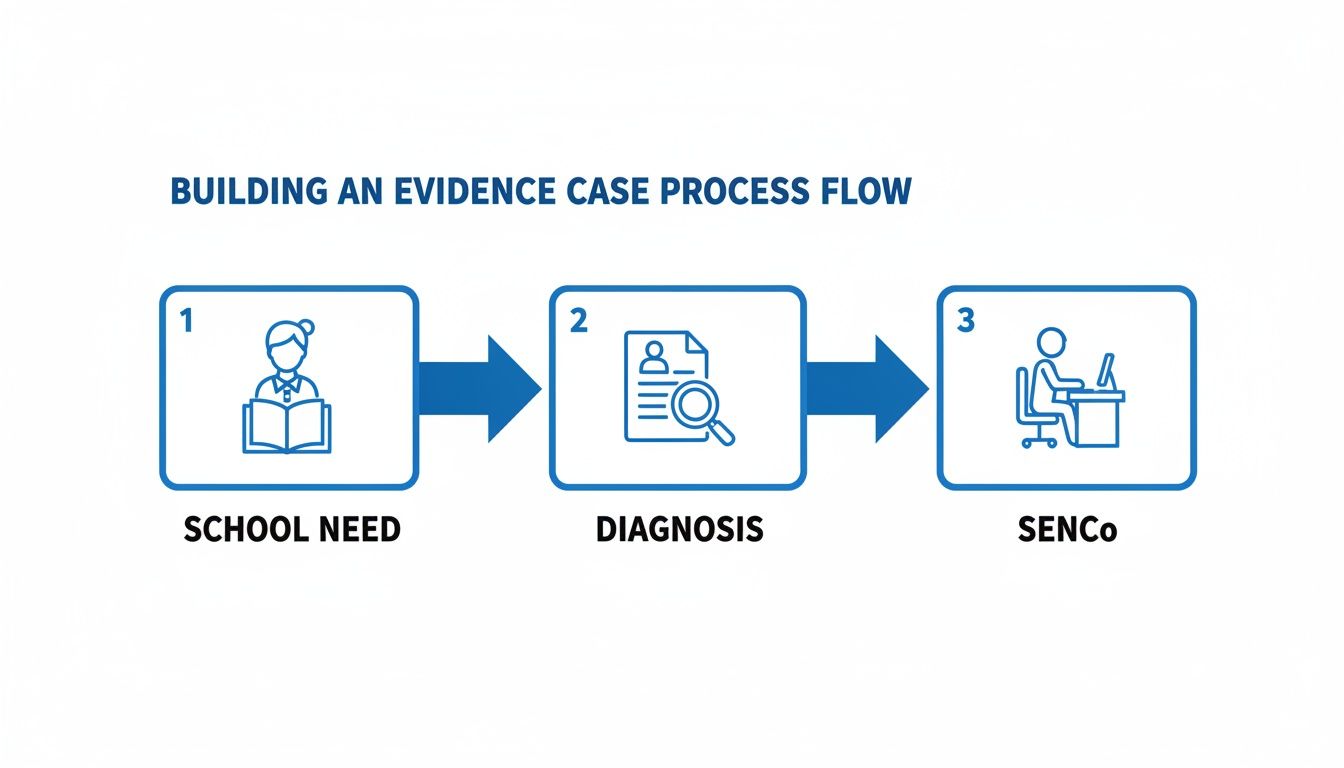
As you can see, what the school has observed, combined with a formal diagnosis, gives the SENCo the foundation they need to build a successful application.
Working Collaboratively to Build the Strongest Case
Your job is to arm the SENCo with clear, organised evidence, but remember, they are the one who ultimately has to be convinced. They have a professional duty to follow JCQ regulations, which means they need proof that the support is genuinely needed and reflects the student's 'normal way of working'.
It’s also worth knowing that the conversation around extra time has been muddied by some inaccurate figures in the past. An important Ofqual probe into exam extra time figures on feweek.co.uk found that data between 2014 and 2024 was hugely overstated because exam boards kept pupils on their systems for up to 26 months. The corrected data shows that the number of students getting support is much more in line with the 14.2% of pupils identified with special educational needs (SEN).
During your discussions, focus on painting a complete picture of the student’s needs. Don't be afraid to ask questions to make sure you’re both on the same page.
Key Questions to Ask the SENCo:
- "What in-school assessments do you need to conduct to support this application?"
- "Is there any other information I can pull from the diagnostic report that would help?"
- "What are the key JCQ submission deadlines we need to hit?"
- "How will we use the mock exams to establish this as their 'normal way of working'?"
When you work together, you cover all the bases. The SENCo knows what the JCQ is looking for, and you have the deep, personal insight into your child’s daily challenges. It truly is a team effort.
Getting a handle on how these arrangements work in the real world is also helpful; our guide on ADHD reasonable adjustments provides more context for these conversations. By tackling the school application process with preparation, a collaborative spirit, and a clear grasp of what’s required, you can build a compelling case that secures the fair support needed to succeed.
Securing University Support with Disabled Students' Allowance
When you make the leap from A-Levels to higher education, the whole system for getting support changes. The familiar school SENCo and JCQ framework are gone. In their place, the key to unlocking the help you need is the Disabled Students' Allowance (DSA).
First things first, it's vital to understand what DSA actually is—and what it isn't. This isn't money that gets paid directly into your bank account. Instead, DSA is a government grant that pays for the specialist equipment and support you need to study on a level playing field with your peers.
This support can cover a surprisingly wide range of things. Think specialist software like text-to-speech readers, or funding for a non-medical helper like a study skills tutor or a mentor. But here's the crucial bit: the DSA itself doesn't automatically grant you extra time in exams.
The Gateway to Reasonable Adjustments
So, if DSA doesn't grant extra time, how do you get it? The real magic happens during your Needs Assessment. Once Student Finance confirms you're eligible for DSA, they'll pay for you to have a one-on-one session with a specialist assessor. Don't worry, this isn't a test! It’s really just a structured conversation to figure out the specific barriers your ADHD might create in a university setting.
After that chat, the assessor writes up a detailed report. This report is your golden ticket. It will recommend specific support and adjustments tailored just for you. It’s this official document that your university’s disability services team will use to put their own 'reasonable adjustments' in place—and that’s where the extra exam time comes from.
While your university is the one that officially grants the extra time, they will almost always follow the recommendations laid out in your DSA Needs Assessment report. This report gives them the independent, expert evidence they need to confidently set up your support.
Starting Your DSA Application
One of the best pieces of advice I can give is to get started on your DSA application early. You can do it as soon as you apply for your main student finance, and you don’t even need a confirmed university place to kick things off.
I really can't stress this enough: start early! The whole process, from the initial application to actually having the support in place, can take several months. Getting the ball rolling as soon as you can means everything will be ready for your first day.
Here’s a quick rundown of how it usually works:
- Apply for DSA through your student finance body (like Student Finance England).
- Provide Your Evidence. This is where you'll need to submit proof of your condition. A comprehensive ADHD diagnostic report is exactly what they're looking for.
- Book Your Needs Assessment. Once they confirm you're eligible, you'll be invited to book this.
- Attend the Assessment. You'll talk through your needs with the assessor, who then writes up their report.
- Get Your Entitlement Letter. Student Finance sends a letter confirming the specific support they will fund.
- Share it with Your Uni. You give a copy of the Needs Assessment report to the university's disability and inclusion team, and they take it from there to arrange your adjustments.
It's a common myth that DSA is a benefit you have to fight for. The reality is that it's an entitlement, specifically designed to ensure everyone can access education. With a clear diagnosis, the process is usually very straightforward and sets you up for success.
Your ADHD diagnosis is the key that unlocks this entire support system. If you want to explore the financial side of things in more detail, our guide on whether you can get a disability allowance for ADHD offers some excellent additional information.
Navigating the transition to university can feel overwhelming, but the DSA framework is there to make sure you're not left behind. By understanding its role and starting your application in good time, you can have vital support, including that all-important extra time in exams, ready and waiting from day one. That leaves you free to focus on what really matters: your studies.
Common Mistakes and How to Avoid Them

Getting extra time in exams sorted can feel like a project in itself. From my experience, a few common slip-ups can unfortunately trip up an application that should have sailed through. Knowing what these are ahead of time is your best defence for a smooth, successful outcome.
The biggest mistake I see parents and students make is simply leaving it too late. There's often an assumption that it's a conversation for just before the mock exams in Year 11. But by then, you might find the crucial deadlines set by the Joint Council for Qualifications (JCQ) have already passed you by.
This delay just piles on the pressure and shrinks the time the school has to gather all the necessary evidence. It’s all about being proactive, not reactive.
Waiting Too Long to Contact the School
Honestly, procrastination is the number one enemy here. The process for getting access arrangements isn't just filling out a form; it involves meetings, potential in-school assessments, and a mountain of meticulous paperwork for the Special Educational Needs Coordinator (SENCo). It all takes time.
Here's how to get ahead of the game:
- Start the conversation early. The best time to have that first chat with the SENCo is right at the start of the exam course—think the beginning of Year 10 for GCSEs or Year 12 for A-Levels.
- Use school events as a prompt. Parent-teacher evenings or the first school report of the academic year are perfect, natural moments to book that initial meeting.
Getting in there early gives the SENCo plenty of runway to put a solid plan in place. It means any support, like using a laptop or having supervised rest breaks, can be tested out and documented long before any deadlines loom. It turns a last-minute panic into a well-managed plan.
Misunderstanding the 'Normal Way of Working' Rule
Another major hurdle is not quite getting the ‘normal way of working’ principle. You can’t just show up with an ADHD diagnosis a month before the exam and expect extra time to be automatically granted. It doesn't work like that.
The JCQ is crystal clear on this: any support given in a formal exam must mirror what the student has been consistently using in class and during internal school tests. The school has to demonstrate a history of need.
For instance, if a student needs 25% extra time, the SENCo’s application must include evidence showing this was provided and made a difference during mock exams or even just timed essays in class. A private diagnosis is vital evidence that explains why the support is needed, but it’s the school’s records that prove that it's needed day-to-day.
Your diagnostic report provides the medical foundation, but the school’s evidence of a ‘normal way of working’ is the practical proof the exam board needs. You can't have one without the other.
To get this evidence locked down, work closely with the SENCo. Make sure the adjustments you've agreed on are being used consistently across all subjects, not just in the ones where the struggle is most obvious. This creates the watertight paper trail required for a successful application.
Assuming a Diagnosis Is the Only Thing You Need
While a formal diagnosis from a qualified specialist is absolutely essential, it's a mistake to view it as a 'golden ticket'. The report itself needs to be robust, detailed, and give the SENCo the specific information they need to build their case.
A weak or vague report can seriously hold things up. A good diagnostic assessment will do more than just confirm a diagnosis of ADHD.
It should ideally contain:
- Standardised Test Scores: Hard data on things like processing speed, working memory, or reading fluency gives objective proof of the challenges a student faces.
- Clear Recommendations: The report should explicitly recommend specific arrangements (like extra time or a word processor) and clearly explain why they are necessary for that individual.
- A Qualified Assessor: The diagnosis must come from a properly qualified professional, like a chartered psychologist or a specialist teacher who holds the right assessment qualifications (an APC).
When you're looking for a private assessment, it’s so important to choose a clinic that produces reports specifically designed to meet JCQ standards. This gives the SENCo the powerful, data-rich evidence they need to build the strongest possible case for your child.
Your Questions Answered
When you're trying to figure out exam support, it’s natural to have a lot of questions. Let's tackle some of the most common ones that come up for parents, carers, and students.
Does a Private ADHD Diagnosis Guarantee Extra Time in Exams?
This is a big one. While a private ADHD diagnosis is a vital piece of the puzzle, it doesn’t automatically unlock extra time in exams. The final call is made by the school’s Special Educational Needs Coordinator (SENCo), and they have to follow strict rules set by the Joint Council for Qualifications (JCQ).
Think of your diagnosis as the expert medical explanation. It establishes the why. But to get the green light, it has to be backed up by evidence from the school showing how ADHD affects your work under exam pressure. You also need to demonstrate that getting this support is your ‘normal way of working’ in class and during mocks.
It really comes down to two key parts:
- The Formal Diagnosis: This confirms the medical condition.
- The School’s Evidence: This shows the real-world impact in the classroom.
The SENCo will use your diagnostic report as the foundation for the application, but they'll almost certainly carry out their own assessments to build the complete picture required by the exam boards.
What if I’m an Adult Learner at College?
The process is very similar for adults in further education, whether you're studying for A-Levels, BTECs, or other qualifications at college. The fundamental principles don't change, just some of the job titles do.
You'll likely be talking to the college's learning support team or student services department instead of a SENCo. Just like in a school setting, you’ll need to provide solid evidence, and a formal ADHD diagnosis is a critical part of that.
The 'normal way of working' principle is just as important for adult learners. Any support you ask for in final exams—like 25% extra time—needs to be what you’ve been using all along in your coursework and assessments.
The college takes on the responsibility of applying for your access arrangements through the JCQ, managing the process for you just as a school would.
How Long Does Extra Time Last Once Approved?
Once your access arrangements are approved, they are generally valid for up to 26 months, according to JCQ guidelines. This timeframe is deliberately set to cover a full two-year course, like GCSEs or A-Levels, so you don't have to go through the whole application process every single year.
Interestingly, this 26-month validity period has sometimes led to slightly skewed statistics on how many students get support, as a student can remain in the system even after they’ve finished their exams.
A crucial point to remember is that these arrangements are tied to your specific course and qualification level. They don't automatically roll over when you go from college to university. For higher education, you’ll need to start a fresh application for support through the Disabled Students' Allowance (DSA).
Finding the right path to a private ADHD assessment can feel complicated, but it doesn't have to be. ADHD Private offers a free directory of over 85 UK clinics, allowing you to easily compare wait times, costs, and services to find the support you need, faster. Start your search today.